Publications
Publications
• September 2026 •
The Climate and Transformation Fund (KTF) is the most important funding instrument for the transition towards climate neutrality for industry and private households. It is primarily funded by revenue from national and European CO₂ pricing, as well as 10 billion euros annually from the Special Fund for Infrastructure and Climate Neutrality (SVIK). The government’s draft of the KTF’s 2027 economic plan provides for expenditure of 38.9 billion euros, around 3 billion euros more than last year’s financial plan had allocated for this year. However, this larger sum masks some problematic structural changes.
• July 2026 •

Under the proposed Building Modernisation Act (GModG), key challenges in the buildings sector remain unresolved, ranging from emissions reduction to social issues. A new analysis by Öko-Institut and Zukunft KlimaSozial shows how a fair and climate-friendly heating transition in the rented housing sector can be achieved based on four key elements. This requires a mix of policy instruments that drives forward climate protection investments without placing an excessive financial burden on tenants.
• June 2026 •

European member states were supposed to submit their Social Climate Plans by June 30, 2025, in order to receive funding from the Social Climate Fund. Germany’s plan is still pending. A recent analysis by Zukunft KlimaSozial of 17 available plans and drafts from other European countries shows that the process of developing Social Climate Plans has given a significant boost to socially just climate action.
• June 2026 •
Four out of five residential buildings in Germany are single-family or two-family homes. At the same time, recent survey data show that a significant proportion of homeowners have not yet installed a photovoltaic system. Against the backdrop of the planned reform of the Renewable Energy Sources Act (EEG) and the increased focus on self-consumption, the question arises as to which social and demographic factors influence investment decisions and how we can prevent certain social groups from being left behind in the energy transition within their own homes.
• June 2026 •
Around 70 per cent of homeowners with a monthly household income of less than €2,500 do not have a heat pump and do not plan to install one. Among households with an income of more than €7,500, the figure is just 30 per cent. The Building Modernisation Act (GmodG) gives homeowners greater freedom of choice when replacing their heating systems – while also offering the prospect of financial support. Data from the factsheet ‘Heat pumps for homeowners: considering social aspects’ by Initiative Klimaneutrales Deutschland and Zukunft KlimaSozial show just how necessary this support is and what further target-group-specific measures are still required.
• June 2026 •
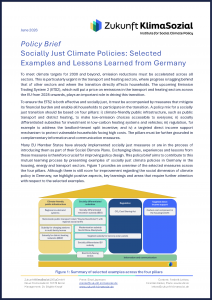
Many EU Member States have already implemented socially fair measures or are in the process of introducing them as part of their Social Climate Plans. Exchanging ideas, experiences and lessons from these measures is therefore crucial to improve policy design. Our Policy Brief aims to contribute to this mutual learning process by presenting examples for socially just climate policies in Germany in the housing, energy and transport sector. Although there is still room for improvement regarding the social dimension of climate policy in Germany, we highlight positive aspects, key learnings and areas that require further attention with respect to the selected examples.
• March 2026 •
A year ago, the €500 billion Special Fund for Infrastructure and Climate Neutrality (SVIK) was approved, including €100 billion for the federal states and local authorities. In an initial analysis, we have examined how these funds are being spent in Brandenburg and Schleswig-Holstein. Unlike at federal level, the investments are not directly tied to the condition of climate neutrality, but are more generally about investment in infrastructure. Nevertheless, it would make sense to take climate protection and climate adaptation into account in these investments. However, this is still not being done to a sufficient extent in the two states examined, Brandenburg (BB) and Schleswig-Holstein (SH).
• February 2026 •
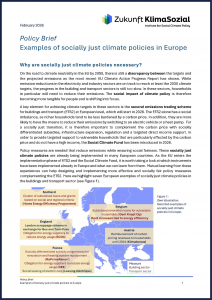
A key element for achieving climate targets in these sectors is the second emissions trading scheme for buildings and transport (ETS2) at European level, which will start in 2028. The ETS2 alone has a social imbalance, as richer households tend to be less burdened by a carbon price. Policy measures are needed that reduce emissions while ensuring social fairness. In our “Policy Brief” we highlight seven European examples of socially just climate policies in the buildings and transport sector which have been implemented already – and what we can learn from them. [Updated and translated version from Feb 25]
• January 2026 •
The second emissions trading scheme for buildings and transport at European level (EU ETS2) was originally supposed to be introduced in 2027, but has been postponed by one year and will now start in 2028. Due to its regulatory effect, ETS2 is an important instrument for achieving climate targets. Our new background paper outlines the role of ETS2 in the mix of instruments, the current German situation with the Fuel Emissions Trading Act (BEHG), what carbon prices can be expected, how social support could be shaped, and what are the most important issues now.
• December 2025 •
The Climate and Transformation Fund (KTF), the central financing element for transformation towards climate-neutrality in Germany, so far has taken social aspects into account only insufficiently. Our new analysis shows that in particular low- and middle-income households benefit only little from the subsidies, even though they bear a major share of the burden of carbon pricing.
• July 2025 •
We propose a reform of renovation subsidies in the current German Federal Funding for Efficient Buildings programme (BEG). Accompanied by associated changes in tenancy law, this can ensure a socially just transition in the building sector for all and provide greater support for low- and middle-income households.
• May 2025 •
In our latest ‘KlimaSozial kompakt’, we show how socially targeted subsidies and relief measures can be structured. This includes a uniformly defined income concept, the establishment of a nationwide register containing income data, tax IDs and account details, and the consistent implementation of the once-only principle. This will also enable state modernisation and reducing bureaucracy of administrative processes.
• March 2025 •
The transformation of the electricity system in Germany is in full swing. Renewable energies increase significantly. In view of the high investment requirements in a relatively short period of time, it is important from a climate and social perspective to develop alternatives to levy financing and to systematically consider and evaluate the needs of low-income households at an early stage and implement support strategies.
• March 2025 •
How can targeted subsidies for electric cars be designed in such a way that they enable lower and middle income groups to switch to electric vehicles while also benefiting the climate and the economy? We (Zukunft KlimaSozial together with Agora Verkehrswende) propose a two-stage approach: The primary goal of the first stage should be to bring electric vehicles to the mass market and introduce income-based subsidies. A second stage should then provide greater support to people who are particularly affected by high carbon pricing. For implementation, we recommend a combination of subsidies for vehicle leasing, purchase loans and purchase grants, differentiated according to vehicle price and income.
• February 2025 •
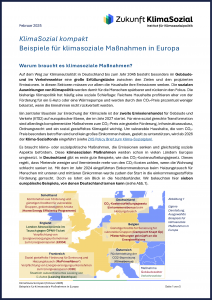
More policy instruments are needed that reduce emissions while at the same time promoting social aspects. These climate and social measures are already being implemented in many European countries. In our ‘KlimaSozial kompakt’ we take a look at our neighbouring countries and present seven European examples from which Germany could learn. [For an updated and translated version see Feb 26]
• September 2024 •
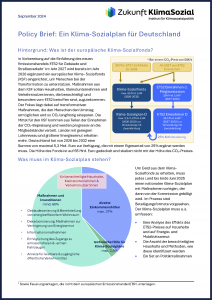
By the end of June 2025, the German government must present a Social Climate Plan for the European Social Climate Fund. Read our Policy Brief to find out what the Social Climate Fund is and what it should include.
• June 2024 •
With the publication of our Summary ‘Securing a socially just and climate-neutral future – 11 Insights for a Social Climate Policy’ in June 2024, we began our work as a new think tank, contributing our expertise, ideas and concepts to the social dialogue.